Parallax gap
The Parallax ViewThe parallax gap is an irreducible difference between perspectives that cannot be reconciled through a neutral viewpoint or a higher synthesis. Its decisive claim is that this difference does not simply separate two already complete things: it can mark a noncoincidence within one thing itself. A change in standpoint therefore does more than alter an observer’s account of an unchanged object. It reveals a division that belongs to the object, and to the reality in which observer and object are entangled.
Definition and Structure
In its standard optical sense, parallax is the apparent displacement of an object against its background when the observer’s position changes and a new line of sight becomes available. The philosophical argument revises the apparent simplicity of that example. The two views cannot be treated as merely subjective descriptions of the same fully constituted thing, because subject and object are already mediated: a shift in the subject’s position also registers an ontological shift in the object as it appears.
The subject’s gaze is, in this account, inscribed in what it sees as a blind spot: a point in the object that cannot be reduced to its visible properties and from which the object seems to return the gaze. The image is not complete and then accidentally obscured from an external observer. It contains a stain indicating that the observer is implicated in the very picture being observed. Materialism accordingly does not mean simply placing the subject inside an objective whole that could be surveyed from outside. It lies in the reflexive short circuit by which the subject is both the one who constitutes the picture and a splinter within it. Reality is incomplete not because some portion remains hidden beyond it, but because its own structure includes this constitutive blind spot.
This account also reverses the familiar arrangement of active subject and passive object. The subject’s founding gesture is described as submitting itself to necessity, while the object’s passivity can become disruptive: it annoys, disturbs, and interrupts the smooth running of things. The object that does the tickling is not simply an inert thing awaiting a subject’s action. It is the parallax object, whose disturbance exposes the instability of the division between observer and observed.
Perspectives Without a Common Ground
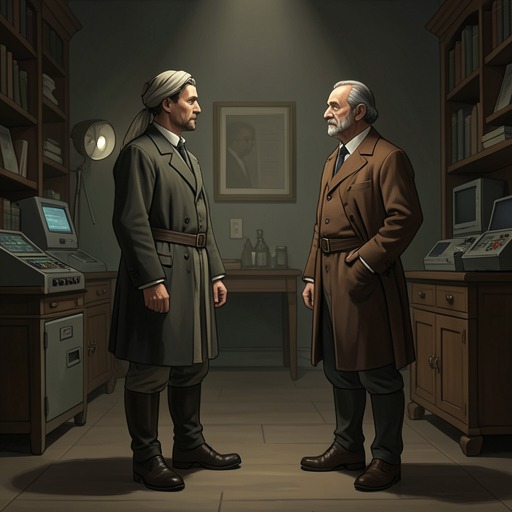
The contrast between Walter Benjamin and Stalin supplies a political example of what cannot be made commensurate. The account describes Stalin as reading Benjamin’s theses and wanting to prevent the publication of a book project based on them. Yet the point is not merely that high culture and brutal politics can collide. The deeper impossibility is that the two positions cannot be translated into a shared register: what Stalin represents cannot grasp the dimensions of Benjamin’s work from within its own perspective. The connection is real, but it does not create a neutral ground on which the perspectives can be reconciled.
The same structure organizes the imagined encounter between Leninist politics and modernist art, figured as Lenin meeting the Dadaists at the Cabaret Voltaire in Zurich. Revolutionary politics and revolutionary art belong to different temporalities. They are linked as two sides of a historical phenomenon, but that relation does not mean that they can directly meet. The comparison with the French Revolution and German Idealism sharpens the point: both belong to one historical moment, yet German Idealism could emerge in the politically backward conditions of a Germany where no political revolution occurred. Historical proximity and structural connection do not guarantee a common space of exchange.
Such encounters exemplify the parallax gap as a confrontation between closely related perspectives for which no neutral common ground exists. At first, this may look like a Kantian antinomy that can never be mediated or sublated. The book’s wager is the reverse: properly theorizing the gap is a necessary first step toward rehabilitating dialectical materialism. The concept does not abandon dialectics in favor of permanently isolated viewpoints; it locates a subversive core of dialectical thought in the impossibility of smoothing their relation into a higher unity.
Forms Across Different Domains
The concept extends beyond political history. In quantum physics, wave-particle duality offers one mode of parallax. In neurobiology, looking behind the face into the skull does not disclose a hidden person at home, but piles of gray matter; the gap between meaning and the pure Real cannot be dismissed by searching for a substantial self behind appearances. The parallax of ontological difference likewise resists reduction in either direction: the ontological horizon cannot be reduced to its ontic roots, while the ontic domain cannot simply be deduced from that horizon. Transcendental constitution is not creation.
For Jacques Lacan, the Real has no positive, substantial consistency apart from the gap among the perspectives through which it is approached. The relation between desire and drive supplies a more ordinary illustration. Someone trying to grasp an object that repeatedly eludes them may shift from wanting to obtain it to taking pleasure in repeating the failed attempt. The object has not simply changed, nor has the first desire been fulfilled; the change of attitude exposes a different structure of relation. Theories of the unconscious contain another such disparity: interpretations of dreams, everyday errors, and jokes do not share a common measure with theories of drives, even though both belong to Freud’s theoretical work. The discussion also identifies a parallax in the shift from the vagina as the object of penetration to the organ of maternity and birth.
Minimal Difference and the One
The parallax gap is also called minimal difference: a pure difference that is not a difference between two positively existing objects but divides one and the same object from itself. It cannot be grounded in a list of substantial properties. In the example drawn from Henry James’s The Real Thing, a painter hires the impoverished aristocrats Major and Mrs. Monarch as models, but their supposedly authentic social status produces drawings that look fake. The lower-class Miss Churm and the Italian Oronte, by contrast, imitate high-class poses more convincingly. The difference at issue cannot be settled by identifying which models possess the more authentic properties; it emerges in the gap between social reality and its representation.
This logic also recasts antagonism and difference. They are not primordial, externally opposed poles. A system of differences cannot complete itself; equivalence arises as a structural effect of that incompleteness. The tension between immanence and transcendence is therefore secondary to a discord within immanence, just as the opposition between the Same and the Other is secondary to the Same’s noncoincidence with itself. The primordial division is neither a pairing of opposite principles nor a gap between two self-contained entities, but the gap between the One and the Void within it. In this sense, the parallax gap does not restore a hidden unity behind appearances. It names the internal fracture through which a unity appears, and through which dialectical materialism can think change without pretending that every contradiction has a neutral resolution.